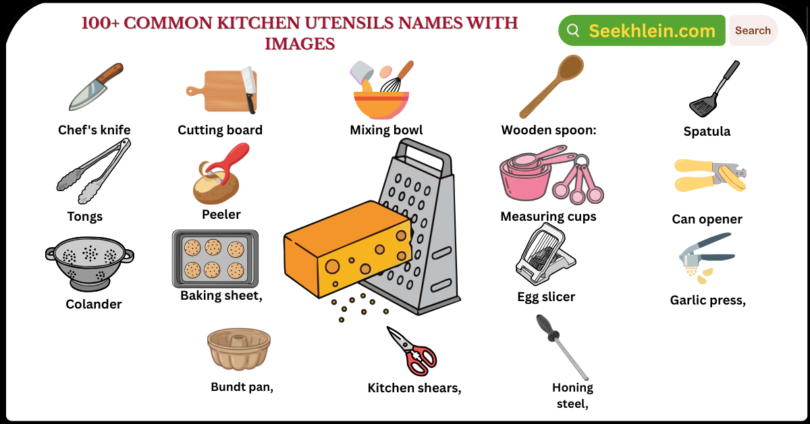

Every kitchen, whether it belongs to a professional chef or a beginner cook, is built around a set of trusted tools. Knowing the correct kitchen utensils names helps you shop smarter, cook faster, and follow recipes without confusion. In this guide, you will find 100+ Common Kitchen Utensils Names with Images along with categories based on their use, such as cutting, mixing, measuring, straining, baking, and serving.
This article is written for home cooks, students, ESL learners, and anyone curious about kitchen tool names and their functions. By the end, you will be able to identify more than 100 kitchen utensils and understand exactly what each one does.
What Are Kitchen Utensils?
Kitchen utensils are small, hand-held tools designed to help you prepare, cook, and serve food. They are different from kitchen appliances, which usually run on electricity, such as blenders or microwaves.
A kitchen utensil can be as simple as a wooden spoon or as specialized as a zester. These 100+ Common Kitchen Utensils Names with Images tools make cooking easier, safer, and more precise. Without them, tasks like peeling a potato, whisking eggs, or draining pasta would take much longer and be far messier.
Kitchen utensils generally fall into a few broad groups:
- Cutting and peeling tools
- Mixing and stirring tools
- Measuring tools
- Straining and draining tools
- Baking preparation tools
- Serving tools
Understanding these categories makes it much easier to remember what each utensil is used for, rather than memorizing a random list of names.
Why Is It Important to Learn Kitchen Utensils Names?
- Improves English vocabulary.
- Helps follow recipes accurately.
- Makes shopping for kitchen tools easier.
- Enhances cooking confidence.
- Useful for students, travelers, and home cooks.
Common Kitchen Utensils
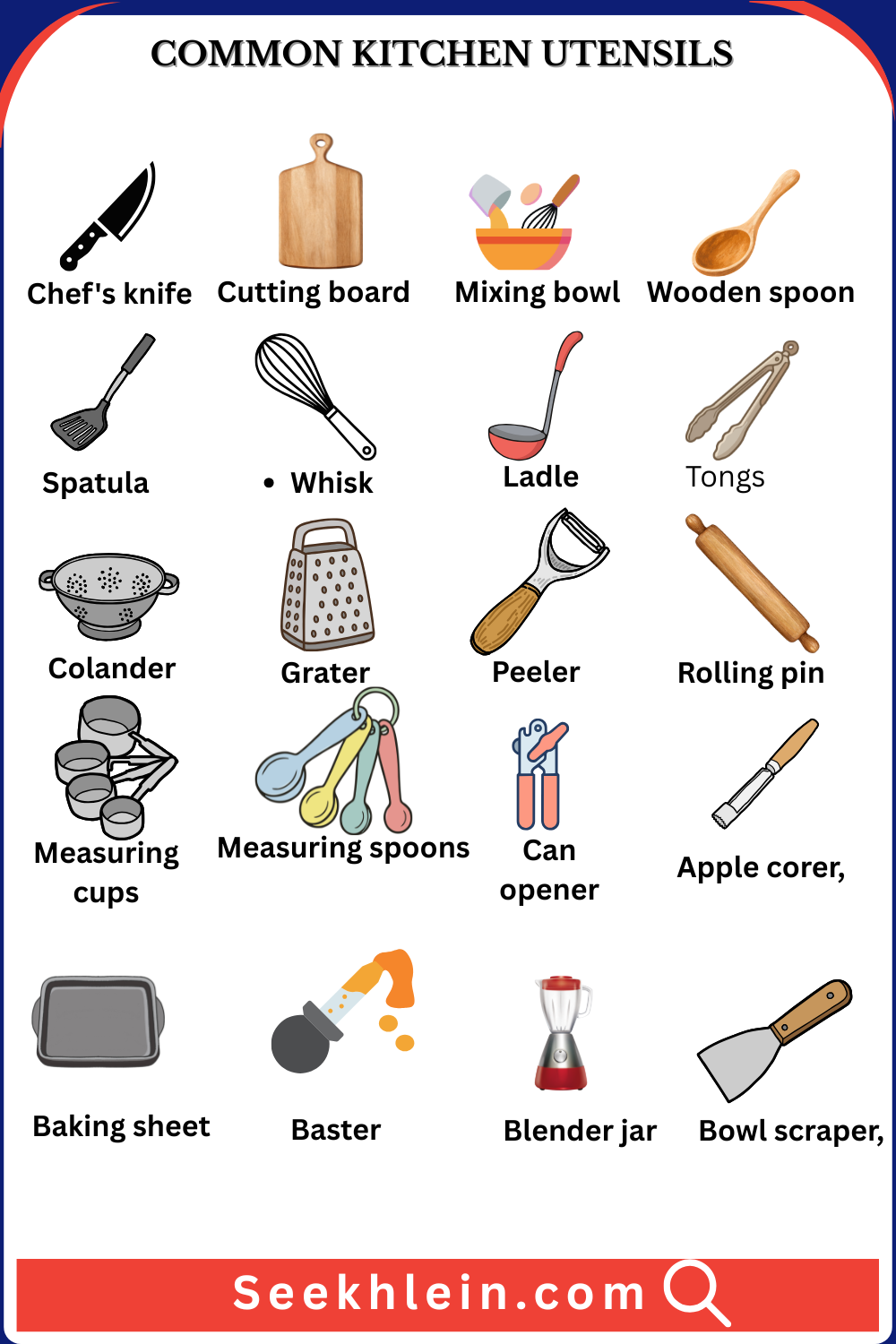
Before diving into the full alphabetical list, here are some of the most commonly used kitchen utensils found in almost every household kitchen:
- Chef’s knife
- Cutting board
- Mixing bowl
- Wooden spoon
- Spatula
- Whisk
- Ladle
- Tongs
- Colander
- Grater
- Peeler
- Rolling pin
- Measuring cups
- Measuring spoons
- Can opener
These fifteen items form the foundation of a functional kitchen. Once you have these basics, you can gradually add more specialized tools depending on the type of cooking you enjoy.
List of Kitchen Utensils A to Z
Here is a detailed kitchen utensils name list, organized alphabetically for easy reference. This section covers over 100 kitchen tools used for cooking, baking, serving, and eating.
Kitchen Utensils from A to F
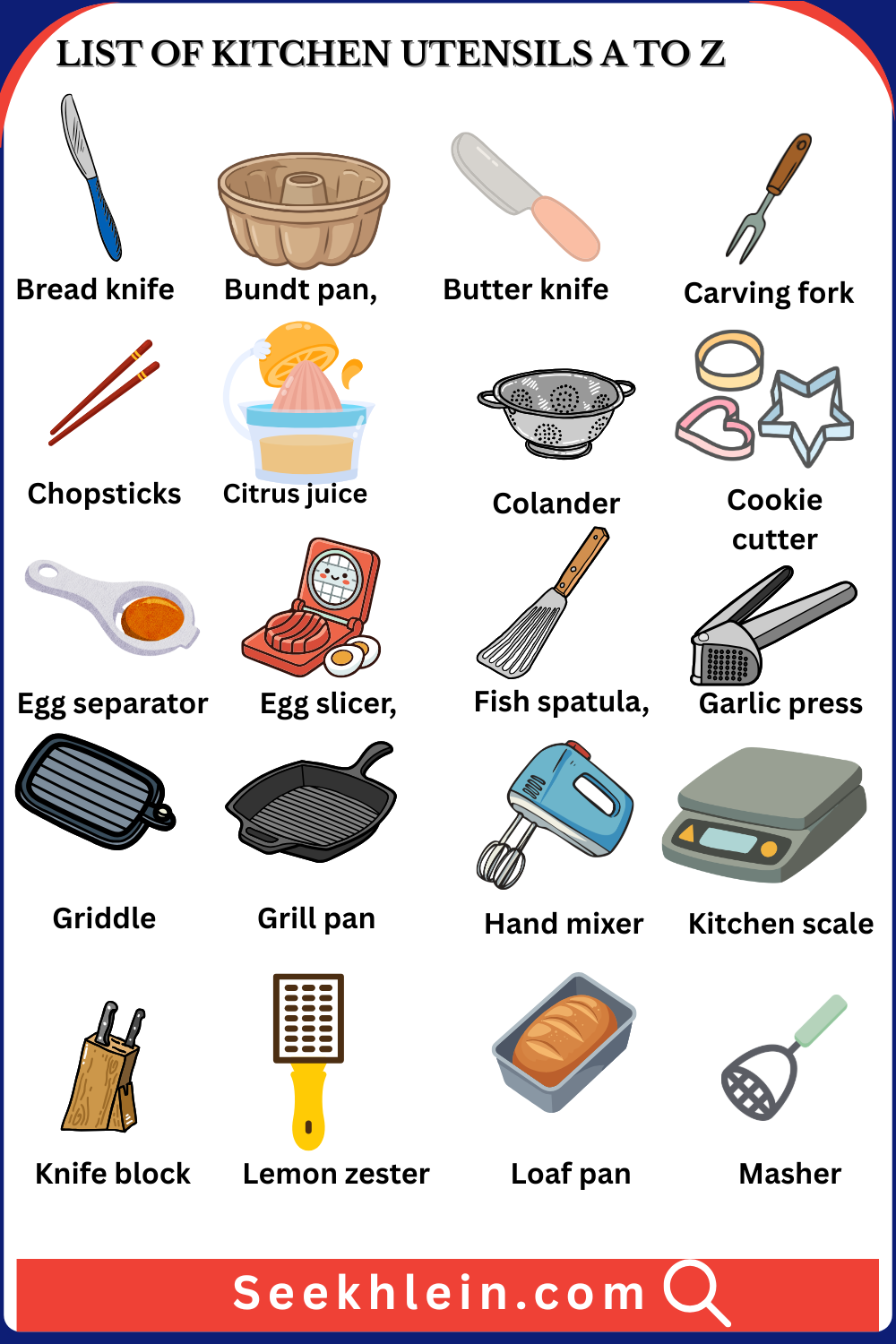
- Apple corer, used to remove the core and seeds from an apple in one motion
- Baking sheet, a flat metal tray used for baking cookies and roasting vegetables
- Baster, used to spread juices or fat over roasting meat
- Blender jar, the container part of a blender used for pureeing
- Bottle opener, used to remove caps from bottles
- Bowl scraper, a flexible tool used to clean out mixing bowls
- Bread knife, a serrated knife designed to slice bread without crushing it
- Bundt pan, a ring-shaped pan used for baking cakes
- Butter knife, a small, blunt knife used for spreading butter
- Can opener, used to open sealed metal cans
- Candy thermometer, used to measure sugar temperature during candy making
- Carving fork, used to hold meat steady while carving
- Cheese grater, used to shred cheese into small pieces
- Chef’s knife, a large, versatile knife used for chopping, slicing, and dicing
- Chopping board, a flat surface used for cutting food
- Chopsticks, slender sticks used for eating, especially in Asian cuisine
- Citrus juicer, used to extract juice from lemons, limes, or oranges
- Colander, a bowl with holes used to drain water from pasta or vegetables
- Cookie cutter, used to cut dough into decorative shapes
- Cooling rack, a wire rack used to cool baked goods evenly
- Corkscrew, used to remove corks from wine bottles
- Cutting board, similar to a chopping board, used for slicing and dicing
- Dough scraper, used to cut and lift dough
- Egg separator, used to separate egg yolks from egg whites
- Egg slicer, used to slice boiled eggs evenly
- Fish spatula, a thin, slotted spatula designed for flipping delicate fish
- Flour sifter, used to sift flour and remove lumps
- Fork, a utensil with prongs used for eating and serving
Kitchen Utensils from G to L
- Garlic press, used to crush garlic cloves quickly
- Grater, used to shred vegetables, cheese, or fruit
- Griddle, a flat cooking surface used for pancakes and similar foods
- Grill pan, a ridged pan used to mimic grill marks indoors
- Hand mixer, an electric tool used to whip or beat ingredients
- Honing steel, used to realign a knife’s edge between sharpenings
- Ice cream scoop, used to serve rounded portions of ice cream
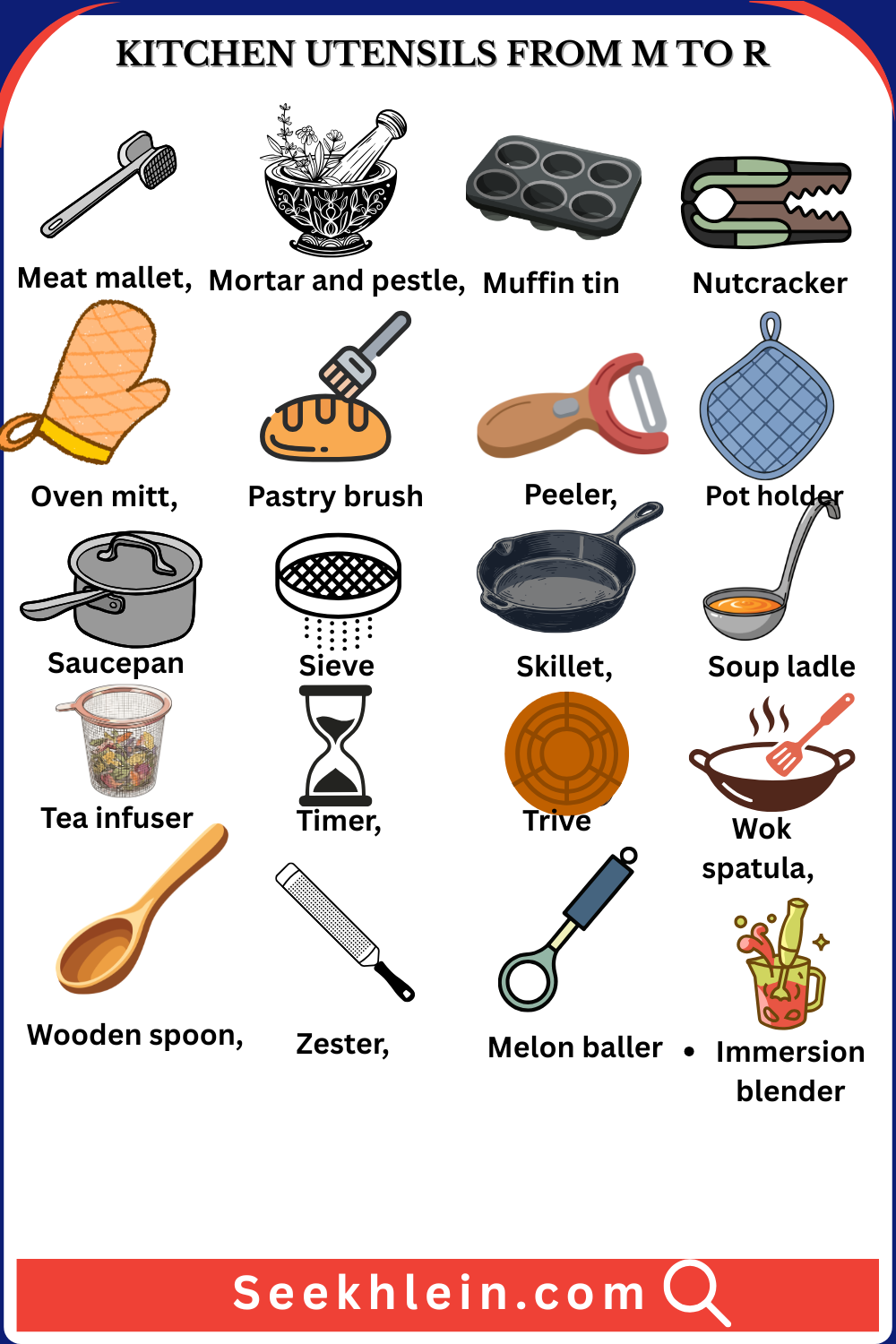
- Immersion blender, a handheld blender used directly in pots or bowls
- Kitchen scale, used to weigh ingredients precisely
- Kitchen shears, scissors designed for cutting herbs, poultry, or packaging
- Kitchen timer, used to track cooking or baking time
- Knife block, used to store knives safely
- Ladle, a deep spoon used to serve soups and stews
- Lemon zester, used to remove the outer peel of citrus fruits
- Loaf pan, a rectangular pan used for baking bread
Kitchen Utensils from M to R
- Mandoline slicer, used to cut vegetables into thin, even slices
- Masher, used to mash boiled potatoes or vegetables
- Measuring cups, used to measure the volume of dry or liquid ingredients
- Measuring spoons, used to measure small amounts of ingredients
- Meat mallet, used to tenderize meat before cooking
- Meat thermometer, used to check the internal temperature of cooked meat
- Melon baller, used to scoop round pieces from melons or other fruits
- Mixing bowl, a bowl used to combine ingredients
- Mortar and pestle, used to grind spices or herbs
- Muffin tin, a pan with cups used to bake muffins or cupcakes
- Nutcracker, used to crack open the shells of nuts
- Oven mitt, a padded glove used to handle hot cookware
- Pancake turner, a wide spatula used to flip pancakes
- Paring knife, a small knife used for peeling and detailed cutting
- Pasta server, a spoon with prongs used to serve pasta
- Pastry brush, used to apply butter, egg wash, or glaze on baked goods
- Pastry cutter, used to cut butter into flour when making dough
- Peeler, used to remove the skin from fruits and vegetables
- Pizza cutter, a wheeled blade used to slice pizza
- Potato masher, used to mash boiled potatoes
- Pot holder, a padded cloth used to hold hot pots safely
- Rolling pin, a cylindrical tool used to flatten dough
- Roasting pan, a deep pan used to roast meat or vegetables in the oven
- Ricer, used to press cooked potatoes into fine strands
Kitchen Utensils from S to Z
- Salad spinner, used to wash and dry salad greens
- Saucepan, a small, deep pan with a handle, used for sauces and boiling
- Sieve, used to strain liquids or sift dry ingredients
- Skillet, a flat frying pan with sloped sides
- Slotted spoon, a spoon with holes used to lift food while leaving liquid behind
- Soup ladle, a deep spoon used to serve soup
- Spatula, a flat tool used to flip, lift, or spread food
- Spoon rest, used to hold a spoon while cooking
- Steamer basket, used to steam vegetables or dumplings
- Strainer, used to separate liquids from solids
- Tea infuser, used to steep loose tea leaves
- Timer, used to track cooking duration
- Tongs, used to grip and lift food without touching it directly
- Trivet, a stand used to protect surfaces from hot cookware
- Vegetable peeler, used to remove the outer skin of vegetables
- Whisk, a wire tool used to beat or mix ingredients
- Wok spatula, a long-handled spatula designed for stir frying
- Wooden spoon, a spoon used for stirring and mixing
- Zester, used to remove fine citrus peel for flavoring
Kitchen Utensils for Cutting and Peeling
Cutting and peeling tools are among the most frequently used items in any kitchen. They help you prepare fruits, vegetables, and meat with precision.
- Chef’s knife
- Paring knife
- Bread knife
- Vegetable peeler
- Mandoline slicer
- Kitchen shears
- Cutting board
- Apple corer
- Melon baller
A sharp chef’s knife paired with a sturdy cutting board can handle most everyday cutting tasks, from dicing onions to slicing meat.
Kitchen Utensils for Mixing and Stirring
Mixing and stirring tools help combine ingredients evenly, whether you are making a simple salad dressing or a complex cake batter.
- Whisk
- Wooden spoon
- Hand mixer
- Mixing bowl
- Spatula
- Immersion blender
- Rubber scraper
These tools ensure that ingredients blend smoothly without lumps, which is especially important in baking recipes where texture matters.
Kitchen Utensils for Measuring
Accurate measurements can make the difference between a recipe that works and one that fails. These tools help you follow recipes exactly as written.
- Measuring cups
- Measuring spoons
- Kitchen scale
- Liquid measuring jug
- Candy thermometer
- Meat thermometer
Bakers, in particular, rely heavily on measuring tools since baking is a more exact science compared to general cooking.
Kitchen Utensils for Straining and Draining
These utensils are essential for separating liquids from solids, whether you are rinsing vegetables or draining pasta.
- Colander
- Strainer
- Sieve
- Salad spinner
- Slotted spoon
A colander is typically used for larger items like pasta, while a fine sieve works better for smaller ingredients like tea leaves or flour.
Kitchen Utensils for Baking Preparation
Baking requires its own set of specialized tools to ensure consistent results every time.
- Rolling pin
- Baking sheet
- Muffin tin
- Loaf pan
- Bundt pan
- Cooling rack
- Pastry brush
- Pastry cutter
- Flour sifter
- Cookie cutter
Having the right baking utensils ready before you start can save time and reduce the chances of a recipe going wrong midway.
Kitchen Utensils for Serving
Once the food is ready, serving utensils help you plate and present meals neatly.
- Ladle
- Serving spoon
- Pasta server
- Tongs
- Cake server
- Gravy boat
- Salad servers
Choosing the right serving utensil not only makes plating easier but also adds a touch of presentation to your meal.
Essential Kitchen Utensils for Beginners
If you are just starting to build your kitchen, you do not need every tool listed above right away. Focus on these essentials first.
- Chef’s knife
- Cutting board
- Mixing bowl set
- Measuring cups and spoons
- Wooden spoon
- Spatula
- Whisk
- Colander
- Tongs
- Vegetable peeler
- Can opener
- Frying pan and saucepan
These twelve items can handle nearly every basic cooking task, from chopping vegetables to boiling pasta and flipping eggs.
Small Kitchen Utensils Used Daily
Beyond the larger tools, several small kitchen utensils get used almost every single day without much notice.
- Can opener
- Bottle opener
- Garlic press
- Zester
- Egg slicer
- Tea infuser
- Spoon rest
- Pastry brush
- Kitchen timer
These small items may seem minor, but skipping them often means resorting to less efficient methods, like using a knife instead of a garlic press.
Tips for Learning Kitchen Utensils Names
- Learn utensils by category.
- Use labeled images for quick recognition.
- Practice using the names while cooking.
- Read English recipes regularly.
- Create flashcards for revision.
Conclusion
Learning the names and uses of kitchen utensils is one of the simplest ways to become a more confident and organized cook. From basic tools like a chef’s knife and cutting board to specialized items like a zester or a candy thermometer, each utensil plays a specific role in helping you prepare food efficiently. Whether you are stocking a kitchen for the first time or brushing up on vocabulary, this alphabetical kitchen utensils name list, combined with category-based groupings, should serve as a handy reference for years to come.
Frequently Asked Questions
What is the most important kitchen utensil for beginners?
A good chef’s knife is generally considered the most important tool, since it handles most cutting tasks in daily cooking.
How many kitchen utensils does a basic kitchen need?
Around ten to fifteen essential items, such as a knife, cutting board, mixing bowl, and measuring cups, are enough to start cooking most everyday meals.
What is the difference between a kitchen utensil and a kitchen appliance?
A kitchen utensil is typically a hand-held, non-electric tool, while a kitchen appliance runs on electricity, such as a blender or toaster.
Which utensil is best for mixing cake batter?
A hand mixer or a sturdy whisk works best for mixing cake batter smoothly and evenly.
What tool is used to drain pasta?
A colander is the standard tool used to drain pasta and remove excess water from cooked vegetables.
Can one knife replace multiple kitchen utensils?
A chef’s knife can handle chopping, slicing, and dicing tasks, but it cannot fully replace specialized tools like a peeler or a zester.
Read More: