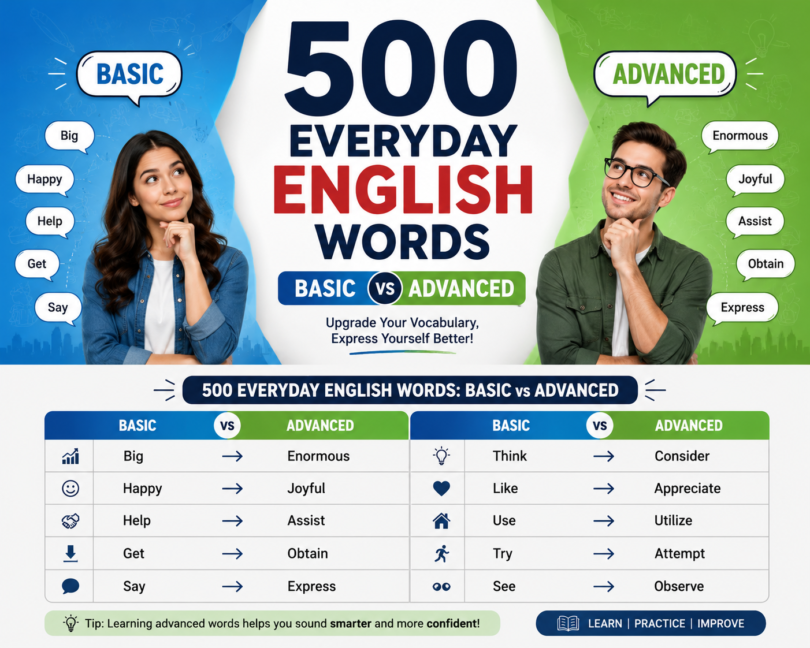

If you want to speak and write English more confidently, upgrading your vocabulary is one of the smartest steps you can take. Most learners rely on simple, everyday words for years without realizing how much stronger their communication could be with just a few smarter word choices. This article brings you 500 Everyday English Words: Basic vs Advanced organized in clear tables to help you compare basic words with their sophisticated alternatives. Whether you are a student, a job seeker, or someone who simply wants to sound more fluent, this complete guide will take your English to the next level.
Why Do We Use Advanced Vocabulary?
We use advanced vocabulary to express our ideas more clearly, precisely, and powerfully. Simple words like “good,” “bad,” or “sad” get the message across, but they rarely leave a strong impression. Advanced words allow you to be specific about what you feel, think, or observe.
For example, instead of saying “He was very angry,” you can say “He was furious” or even “He was livid.” These words carry more weight, more emotion, and more meaning in fewer syllables.
Advanced vocabulary is also essential in formal writing, academic essays, job interviews, business emails, and professional conversations. It signals intelligence, preparation, and a strong command of the language.
Advantages of Advanced Vocabulary
Using a rich and varied vocabulary comes with real, measurable benefits in everyday life. Here are the key advantages:
Clearer Communication: Advanced words eliminate vagueness. You can describe a situation, emotion, or idea exactly as it is, without relying on overused phrases.
Greater Confidence: When you have the right word at the right time, you speak with authority. This confidence shows in presentations, interviews, and conversations.
Better Academic Performance: Essays and assignments written with varied and sophisticated language earn higher marks. Teachers and professors value precise expression.
Professional Growth: In the workplace, people who express themselves well are seen as more competent and reliable. Advanced vocabulary directly impacts career advancement.
Deeper Reading Comprehension: When you recognise advanced words in books, articles, and reports, your reading speed and understanding both improve significantly.
More Persuasive Writing: Whether you are writing an email, a proposal, or a blog post, a strong vocabulary makes your arguments more convincing and your tone more credible.
Table of 500 Normal Vs Advanced English Vocabulary Words
Below is a comprehensive table comparing normal English words with their advanced alternatives. Study these pairs carefully and try to use the advanced versions in your daily writing and speaking.
| Normal Word | Advanced Word | Normal Word | Advanced Word |
| Angry | Furious | Happy | Elated |
| Sad | Melancholy | Tired | Exhausted |
| Smart | Intelligent | Old | Elderly |
| Start | Initiate | End | Conclude |
| Help | Assist | Ask | Inquire |
| Buy | Purchase | Show | Demonstrate |
| Tell | Inform | Use | Utilize |
| Fix | Rectify | Think | Contemplate |
| Go | Depart | Come | Arrive |
| Big | Enormous | Small | Minuscule |
| Fast | Rapid | Slow | Gradual |
| Rich | Affluent | Poor | Impoverished |
| Brave | Courageous | Scared | Apprehensive |
| Funny | Humorous | Serious | Solemn |
| Try | Endeavor | Say | Articulate |
| Make | Fabricate | Break | Shatter |
| Keep | Retain | Give | Bestow |
| Get | Obtain | Look | Observe |
| Like | Appreciate | Want | Desire |
| Need | Require | Know | Comprehend |
500 Daily Used Normal Vs Advanced English Vocabulary Words
Emotions and Feelings
Understanding how to express emotions precisely is one of the biggest leaps in English fluency. Here is a detailed list of emotion-related vocabulary upgrades.
| Normal Word | Advanced Word | Meaning |
| Happy | Euphoric | Intensely joyful |
| Sad | Despondent | Deeply unhappy |
| Angry | Incensed | Extremely angered |
| Excited | Exhilarated | Thrillingly stimulated |
| Worried | Anxious | Feeling nervous concern |
| Calm | Composed | Peacefully in control |
| Proud | Elated | Joyfully proud |
| Shy | Introverted | Preferring inner world |
| Bored | Lethargic | Lacking energy or interest |
| Confused | Perplexed | Completely puzzled |
| Surprised | Astonished | Greatly shocked |
| Satisfied | Gratified | Pleasurably fulfilled |
| Jealous | Envious | Resentfully desiring |
| Lonely | Isolated | Cut off from others |
| Hopeful | Optimistic | Positively expectant |
500 Daily Used Normal Vs Advanced English Vocabulary Words
Actions and Verbs
Replacing weak action words with stronger, more precise verbs instantly improves your writing and speaking quality.
| Normal Word | Advanced Word | Meaning |
| Walk | Stride | Walk with purpose |
| Run | Sprint | Run at full speed |
| Eat | Consume | Take in food |
| Drink | Imbibe | Drink (formal context) |
| See | Observe | Watch carefully |
| Hear | Perceive | Become aware of |
| Talk | Converse | Have a discussion |
| Write | Compose | Create written work |
| Read | Peruse | Read carefully |
| Build | Construct | Put together |
| Destroy | Demolish | Completely break down |
| Change | Transform | Make a major shift |
| Improve | Enhance | Make better |
| Decide | Determine | Reach a conclusion |
| Fight | Confront | Face with force |
Daily Used Normal Vs Advanced English Vocabulary Words
Describing People and Personality
| Normal Word | Advanced Word | Meaning |
| Kind | Benevolent | Generous and good |
| Mean | Malicious | Intending harm |
| Clever | Astute | Keenly perceptive |
| Lazy | Indolent | Habitually idle |
| Honest | Sincere | Genuinely truthful |
| Rude | Insolent | Boldly disrespectful |
| Polite | Courteous | Respectfully gracious |
| Brave | Valiant | Showing great courage |
| Stubborn | Obstinate | Refusing to change |
| Careless | Negligent | Failing to take care |
| Talkative | Loquacious | Excessively talkative |
| Quiet | Reserved | Preferring little talk |
| Curious | Inquisitive | Eager to know |
| Creative | Innovative | Producing new ideas |
| Hardworking | Diligent | Showing steady effort |
Daily Used 500 Normal Vs Advanced English Vocabulary Words
Places and Surroundings
| Normal Word | Advanced Word | Meaning |
| House | Residence | A place to live |
| School | Institution | A learning establishment |
| Road | Avenue | A wide street |
| City | Metropolis | A large urban area |
| Village | Hamlet | A very small settlement |
| Shop | Emporium | A large store |
| Forest | Woodland | A large area of trees |
| River | Tributary | A smaller river feeding a bigger one |
| Mountain | Summit | The top of a mountain |
| Beach | Shoreline | The edge of water |
| Park | Reserve | A protected natural area |
| Office | Workspace | A place for professional work |
| Library | Repository | A collection of resources |
| Hospital | Medical Center | A place for healthcare |
| Farm | Agricultural land | Land used for crops |
500 Daily Used Normal Vs Advanced English Vocabulary Words
Time and Events
| Normal Word | Advanced Word | Meaning |
| Start | Commencement | The beginning of something |
| End | Culmination | The final point |
| Soon | Imminently | About to happen very soon |
| Late | Belated | Happening after expected time |
| Early | Preceding | Coming before |
| Often | Frequently | Happening many times |
| Rarely | Seldom | Not often |
| Now | Currently | At this moment |
| Always | Perpetually | Without end |
| Never | Infrequently | Almost not at all |
| Daily | Routinely | On a regular basis |
| Quick | Instantaneous | Happening immediately |
| Slow | Gradual | Happening little by little |
| Long | Extended | Lasting for a long time |
| Short | Brief | Lasting a short time |
Daily Used Normal Vs Advanced English Vocabulary Words
Communication and Language
| Normal Word | Advanced Word | Meaning |
| Say | Articulate | Express clearly |
| Ask | Inquire | Request information |
| Answer | Respond | Give a reply |
| Explain | Elaborate | Give more detail |
| Repeat | Reiterate | Say again |
| Agree | Concur | Share the same opinion |
| Disagree | Dispute | Challenge a view |
| Lie | Fabricate | Create a false story |
| Promise | Pledge | Make a serious commitment |
| Warn | Caution | Give a warning |
| Suggest | Recommend | Put forward an idea |
| Praise | Commend | Express approval of |
| Criticize | Condemn | Express strong disapproval |
| Discuss | Deliberate | Consider carefully |
| Describe | Depict | Create a picture with words |
Normal Vs Advanced English Vocabulary Words
Nature and Environment
| Normal Word | Advanced Word | Meaning |
| Rain | Precipitation | Water falling from the sky |
| Wind | Gust | A burst of wind |
| Fire | Inferno | An intense, uncontrolled fire |
| Water | Aqua | Liquid water (formal) |
| Earth | Terrain | A stretch of land |
| Tree | Vegetation | Plant life generally |
| Animal | Creature | A living being |
| Sky | Atmosphere | The layer above Earth |
| Sun | Solar body | The star at center of our system |
| Moon | Lunar surface | The natural satellite of Earth |
| Flower | Flora | Plant life |
| Stone | Mineral | A naturally occurring substance |
| Fog | Mist | Light water vapor in air |
| Storm | Tempest | A violent weather event |
| Snow | Precipitation | Frozen water falling as flakes |
Normal Vs Advanced English Vocabulary Words
Work and Business
| Normal Word | Advanced Word | Meaning |
| Job | Occupation | A person’s work or profession |
| Boss | Executive | A high-level manager |
| Worker | Employee | A person who works for another |
| Pay | Remuneration | Payment for work done |
| Plan | Strategy | A detailed action plan |
| Meeting | Conference | A formal gathering |
| Problem | Complication | A difficulty or challenge |
| Result | Outcome | The final effect |
| Goal | Objective | A desired end point |
| Team | Consortium | A group working together |
| Check | Evaluate | Assess carefully |
| Report | Documentation | An official written account |
| Share | Disseminate | Spread widely |
| Grow | Expand | Increase in size or scope |
| Stop | Terminate | Bring to an end |
Normal Vs Advanced English Vocabulary Words
Health and Body
| Normal Word | Advanced Word | Meaning |
| Sick | Afflicted | Affected by illness |
| Tired | Fatigued | Feeling extreme tiredness |
| Hurt | Injured | Physically harmed |
| Strong | Robust | In excellent physical health |
| Weak | Frail | Physically fragile |
| Doctor | Physician | A medical professional |
| Medicine | Medication | A substance used for treatment |
| Pain | Discomfort | An unpleasant sensation |
| Sleep | Slumber | Rest during sleep |
| Eat | Nourish | Provide with nutrition |
| Fat | Obese | Having excessive body weight |
| Thin | Slender | Attractively slim |
| Breathe | Respire | Take in oxygen |
| Mind | Psyche | The human mental system |
| Body | Physique | A person’s physical build |
Conclusion
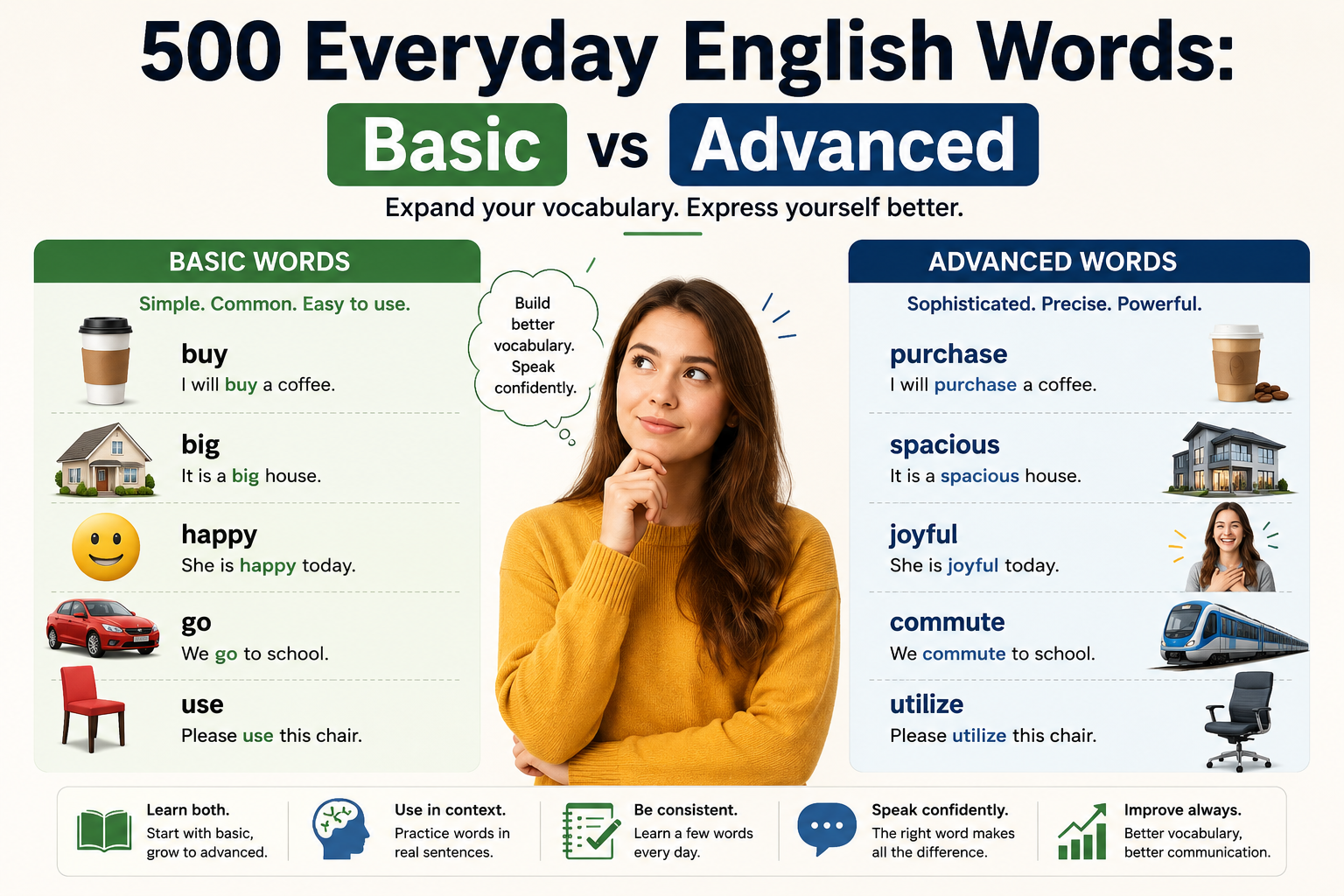
Building a strong English vocabulary is not about memorizing thousands of words overnight. It is about making small, consistent upgrades to the words you already use every day. This list of 500 Everyday English Words: Basic vs Advanced gives you a powerful foundation to speak more clearly, write more effectively, and communicate with greater confidence in every situation.
FAQs
What is the difference between normal and advanced English vocabulary?
Normal vocabulary includes basic, everyday words like “happy” or “tired,” while advanced vocabulary uses more precise alternatives like “elated” or “exhausted” to express the same ideas more powerfully.
Why should I learn advanced English vocabulary words?
Advanced vocabulary improves your speaking, writing, academic results, and professional communication, making you sound more fluent and confident in English.
How can I practice these 500 vocabulary words daily?
Write five sentences using new words each day, use flashcards, read English books or articles, and try replacing simple words with their advanced equivalents during conversation.
Will advanced vocabulary help me in exams?
Yes, using varied and sophisticated vocabulary in essays and written exams significantly improves your score in English language assessments.
How long does it take to learn 500 new vocabulary words?
With consistent daily practice of 10 to 15 words per day, you can learn and actively use 500 vocabulary words in approximately five to seven weeks.
Can beginners use this normal vs advanced vocabulary list?
Absolutely. This list is organized clearly with meanings and examples, making it easy for beginners to start with simple pairs and gradually move to more complex words.
Is it better to use advanced vocabulary in every sentence?
No, the key is balance. Use advanced words when they fit naturally and add clarity. Overusing them can make your speech sound unnatural or forced.
Read more: