
Picking a new hairstyle can feel overwhelming. There are countless cuts, lengths, and textures to choose from, and salon vocabulary doesn’t always make things easier. If you’ve ever sat in a stylist’s chair unsure how to describe what you want, you’re not alone.
This guide breaks down 100+ Trending Women’s Haircuts with Pictures You’ll Love organized by length, texture, and occasion, so you can walk into your next salon appointment knowing exactly what to ask for. Whether you want a low-maintenance pixie cut, a romantic bridal updo, or protective braids that last for weeks, you’ll find it here — along with tips on choosing a style that actually suits your face shape and hair type.
Women’s Hairstyles Chart
Before diving into individual styles, it helps to see how hairstyles are generally grouped. Most professional stylists sort hairstyles into a few core categories:
- By length: short, medium, long
- By cut shape: bob, lob, pixie, shag, layers
- By texture: straight, wavy, curly, coily
- By styling: braids, buns, ponytails, updos
- By occasion: everyday, formal, protective, trendy
Here’s a quick snapshot of how popular styles map to hair length, so you can jump to the section that fits you best:
- Short (chin length or above): pixie cut, buzz cut, bowl cut, boy cut, cropped shag
- Medium (chin to shoulder): bob, lob, shag, curtain bangs with layers, butterfly cut
- Long (past shoulder): long layers, mermaid waves, V-cut, U-cut, chandelier layers
Keep this chart in mind as you read — many styles below can be adapted to different lengths depending on your stylist’s approach.
Short Hairstyles for Women
Short haircuts are bold, easy to maintain, and surprisingly versatile. They work well for busy schedules and hot climates, and they tend to highlight facial features like the eyes and cheekbones.
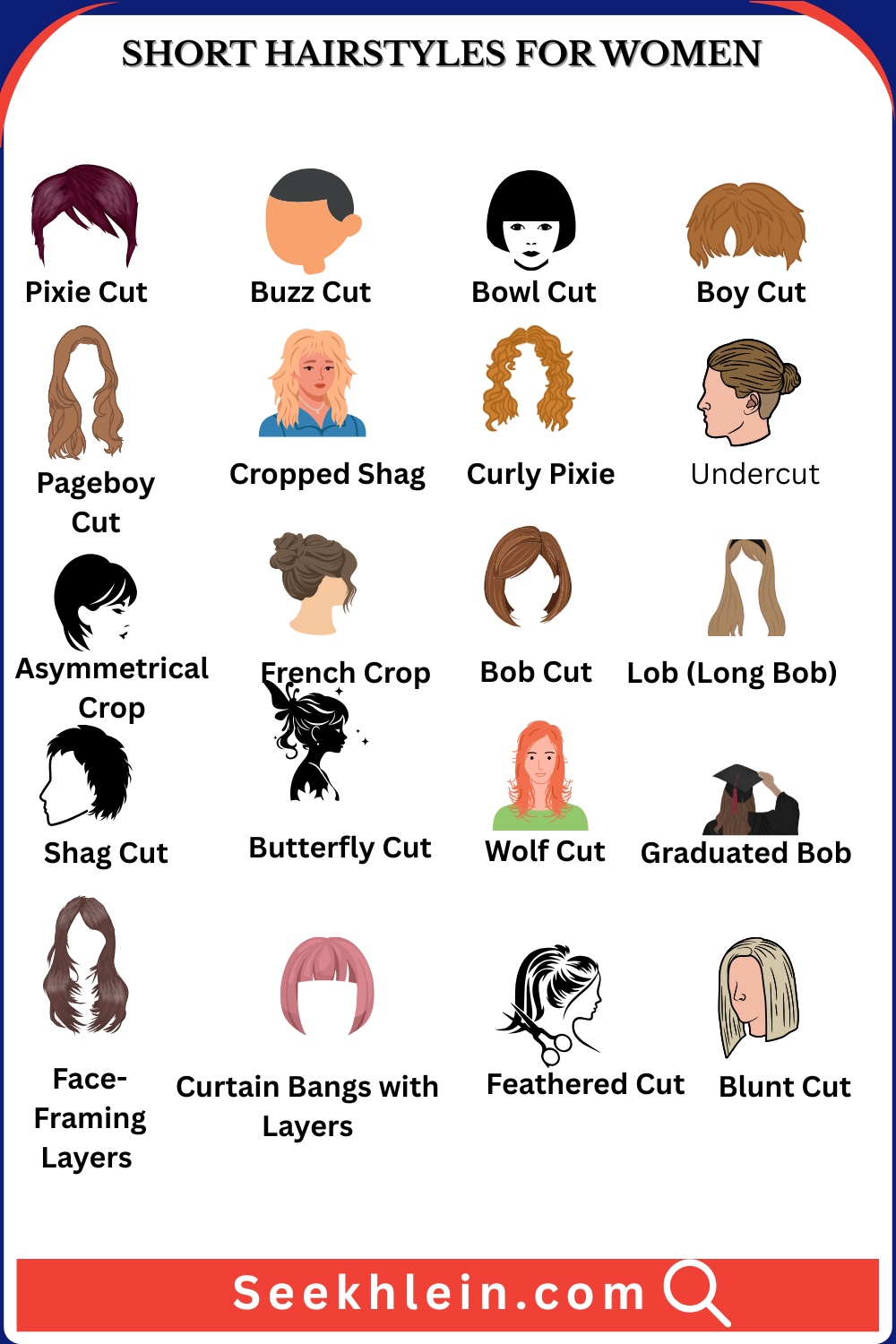
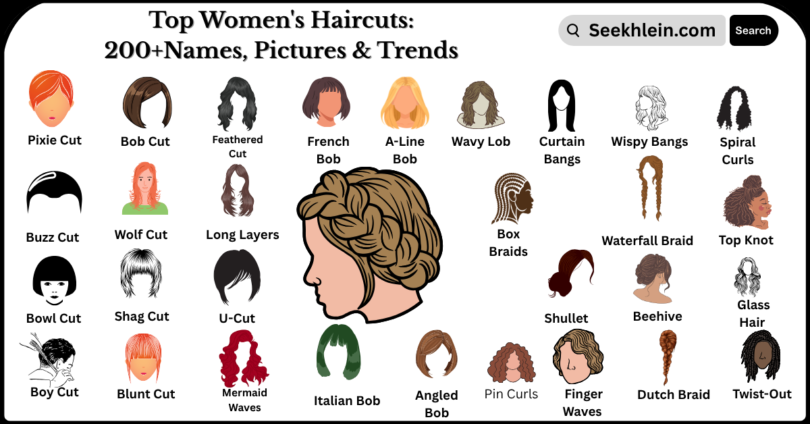
- Pixie Cut – A cropped style with short sides and slightly longer layers on top.
- Buzz Cut – Hair trimmed very close to the scalp for a low-maintenance look.
- Bowl Cut – Rounded, even-length hair that resembles an upside-down bowl shape.
- Boy Cut – A neat, close crop inspired by classic men’s hairstyles.
- Pageboy Cut – Sleek, even-length hair with rounded, curved-under ends.
- Cropped Shag – A short shag with choppy, textured layers for volume.
- Curly Pixie – A pixie cut styled with natural curls for extra bounce.
- Undercut – One section shaved or clipped short beneath longer hair on top.
- Asymmetrical Crop – Uneven short layers, often longer on one side than the other.
- French Crop – A short textured cut with a defined fringe, borrowed from menswear trends.
Short cuts require regular trims (every four to six weeks) to keep their shape, but they save time on daily styling.
Medium Hairstyles for Women
Medium-length hairstyles strike a balance between the ease of short hair and the versatility of long hair. They’re ideal if you want styling options without heavy upkeep.
- Bob Cut – Straight, even hair that typically falls around the chin or jaw.
- Lob (Long Bob) – A longer bob that usually rests near the shoulders.
- Shag Cut – Choppy, layered hair with plenty of texture and movement.
- Butterfly Cut – Heavily layered hair designed to frame the face like wings.
- Wolf Cut – A shaggy, textured mix of a mullet and a shag with wild layers.
- Graduated Bob – A bob with stacked layers underneath for extra fullness.
- Face-Framing Layers – Soft layers cut around the face to highlight features.
- Curtain Bangs with Layers – Center-parted fringe combined with layered medium hair.
- Feathered Cut – Ends styled outward for a light, airy finish.
- Blunt Cut – Hair trimmed straight across with no layering for a sharp edge.
Medium hairstyles suit most face shapes and hair textures, which is part of why they remain so popular year after year.
Long Hairstyles for Women
Long hair offers the most flexibility for styling — from sleek and straight to loose and wavy — though it usually needs more care to stay healthy.
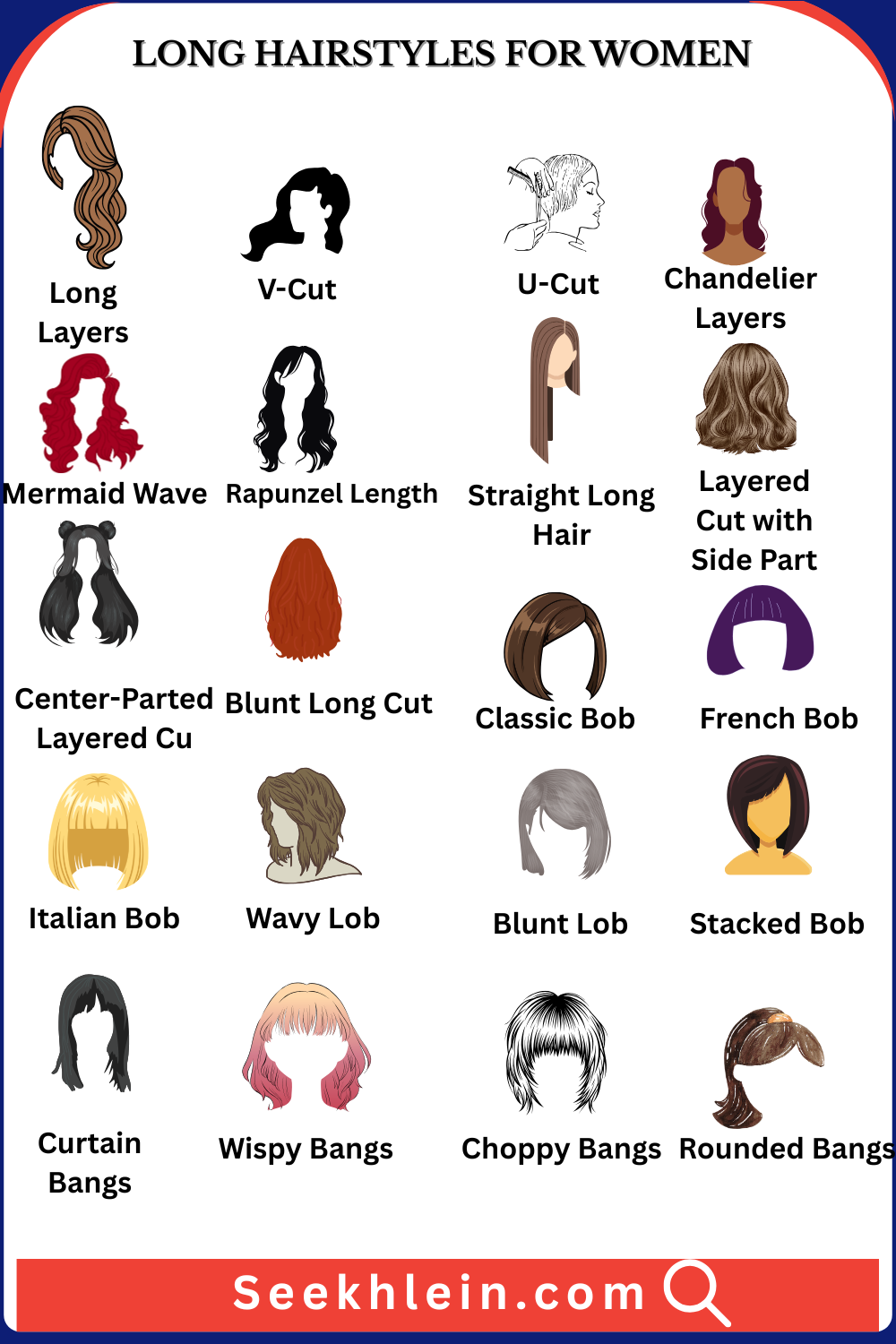
- Long Layers – Cascading layers that add movement without losing length.
- V-Cut – Hair cut into a V shape at the back for a dramatic point.
- U-Cut – Rounded ends shaped like a U for a softer silhouette.
- Chandelier Layers – Long, face-framing layers that add volume around the crown.
- Mermaid Waves – Loose, tousled waves reminiscent of beachy hair.
- Rapunzel Length – Extremely long hair reaching the waist or beyond.
- Straight Long Hair with Bangs – Sleek, straightened length paired with full fringe.
- Layered Cut with Side Part – Long layers combined with a deep side parting.
- Center-Parted Layered Cut – Soft layers falling evenly from a middle part.
- Blunt Long Cut – Long hair with straight, unlayered ends for maximum thickness.
If you’re growing your hair out, regular dusting (trimming just the very ends) helps prevent split ends without sacrificing length.
Bob and Lob Hairstyles
Bobs deserve their own spotlight because there are so many variations. This cut has stayed fashionable for nearly a century, and modern versions keep evolving.
- Classic Bob – Even-length hair ending around the jaw.
- French Bob – A shorter, chin-length bob often paired with bangs.
- Italian Bob – A slightly longer, voluminous bob with soft movement.
- Angled Bob – A bob that’s shorter in the back and longer toward the front.
- A-Line Bob – Similar to the angled bob, with a sharp diagonal line.
- Stacked Bob – Layers stacked at the back for extra height and volume.
- Textured Lob – A long bob with choppy ends for a relaxed vibe.
- Wavy Lob – A long bob styled with loose waves.
- Blunt Lob – A long bob cut straight across with no layering.
- Curly Bob – A bob cut specifically to work with natural curl patterns.
Bangs and Fringe Hairstyles
Bangs can transform a hairstyle instantly, softening the face or adding a trendy edge without committing to a full haircut change.
- Curtain Bangs – Fringe parted in the middle to frame both sides of the face.
- Blunt Bangs – A straight-across fringe cut at one length.
- Side-Swept Bangs – Fringe angled and swept to one side.
- Micro Bangs – Very short, baby bangs cut high on the forehead.
- Wispy Bangs – Thin, feathered fringe with a soft, textured edge.
- Choppy Bangs – Uneven, textured fringe with a lived-in look.
- Long Side Bangs – Longer fringe blended into the layers on one side.
- Rounded Bangs – Fringe cut in a soft curve rather than a straight line.
Curly and Wavy Hairstyles
Curly and wavy hair has its own set of go-to styles, many designed to enhance natural texture rather than fight it.
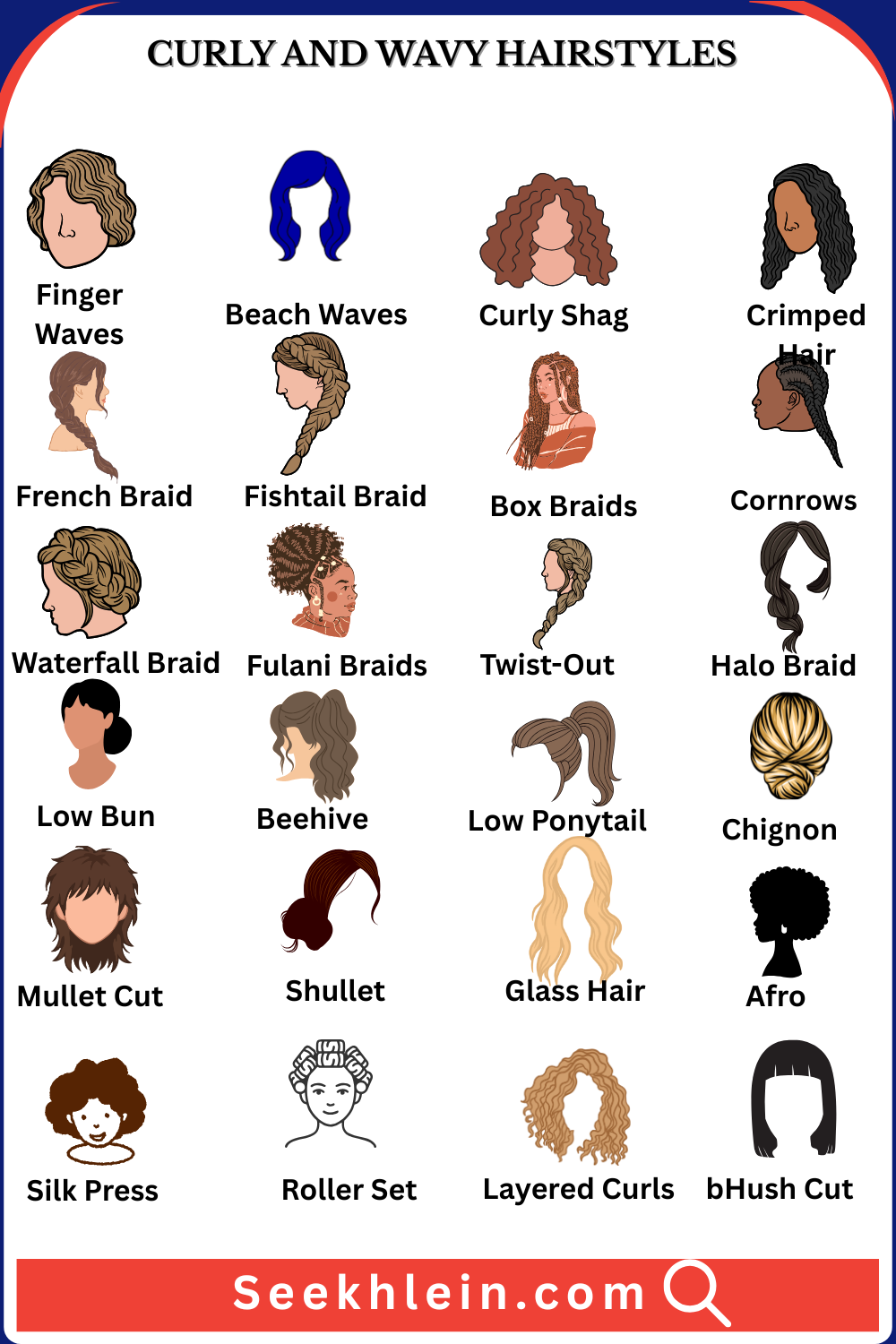
- Natural Curls – Hair left to air-dry and settle into its own curl pattern.
- Beach Waves – Loose, tousled waves that mimic salt-air texture.
- Finger Waves – A vintage style with defined “S”-shaped waves.
- Spiral Curls – Tight, uniform curls formed with a curling wand.
- Curly Shag – A shag cut layered specifically for curly hair types.
- Wavy Bob – A bob styled with soft, textured waves.
- Deep Waves – Pronounced, defined waves with noticeable pattern.
- Crimped Hair – Hair styled with tight, zig-zag texture using a crimping iron.
- Sleek Waves – Smooth, glossy waves with a polished finish.
- Pin Curls – Curls set close to the head using pins, then released for bounce.
Braided and Protective Hairstyles
Braided styles are practical, long-lasting, and often double as protective hairstyles that shield hair from daily wear and tear.
- French Braid – A classic three-strand braid woven from the roots down.
- Dutch Braid – Similar to a French braid but woven underneath for a raised effect.
- Fishtail Braid – A braid made from two sections instead of three, for a woven look.
- Box Braids – Individual braids sectioned into square-shaped parts.
- Cornrows – Braids woven flat against the scalp in neat rows.
- Boxer Braids – Two tight braids running along both sides of the head.
- Waterfall Braid – A braid that lets sections “fall” out to blend with loose hair.
- Fulani Braids – Cornrows accented with beads and a center braid.
- Crown Braid – A braid wrapped around the head like a halo.
- Twist-Out – Twisted sections unraveled to create defined, textured waves.
- Senegalese Twists – Long, rope-like twists using extensions.
- Halo Braid – A single braid circling the head for a romantic look.
Bun, Ponytail, and Updo Hairstyles
These are the styles you reach for when you need hair off your face fast, or when you want something polished for a special event.
- Top Knot – A bun tied high on the crown of the head.
- Low Bun – A neat bun positioned at the nape of the neck.
- Messy Bun – A relaxed, loosely pinned bun with pieces left out.
- Space Buns – Two symmetrical buns positioned on either side of the head.
- High Ponytail – A ponytail secured at the very top of the head.
- Low Ponytail – A ponytail gathered at the nape of the neck.
- Bubble Ponytail – A ponytail sectioned with elastics to create bubble shapes.
- Half-Up Half-Down – Hair partly pulled up while the rest is left loose.
- French Twist – Hair rolled inward and pinned vertically at the back.
- Chignon – A low, elegant knot often worn for formal occasions.
- Beehive – Hair teased and piled high for a retro, voluminous updo.
- Victory Rolls – Vintage rolled curls styled on either side of the head.
Modern and Trendy Hairstyles
Social media and celebrity culture continue to push new hairstyle trends every season. These are some of the styles currently dominating salon requests.
- Hush Cut – A softer, blended version of the wolf cut with rounded layers.
- Butterfly Layers – Dramatic, face-framing layers with heavy movement.
- Money Piece Highlights with Layers – Face-framing highlights paired with long layers.
- Shullet – A hybrid of a shag and a mullet with textured volume.
- Mullet Cut – Short at the front and top, longer at the back.
- Curtain Bangs Bob – A bob cut paired with center-parted curtain fringe.
- Glass Hair – Ultra-sleek, straightened hair with a glossy, reflective finish.
- Wet Look Styling – Hair styled with product to appear damp and sleek.
Hair Type-Based Hairstyles
Choosing a hairstyle also depends heavily on your natural hair type. Here are style categories matched to common textures:
- Straight hair: blunt cuts, glass hair, sleek ponytails, classic bobs
- Wavy hair: curtain bangs, wavy lobs, beach waves, shag cuts
- Curly hair: curly bobs, twist-outs, curly pixies, deep waves
- Coily hair: cornrows, box braids, Fulani braids, twist-outs, afros
- Afro – Natural coily hair styled into a round, voluminous shape.
- Silk Press – Chemically untreated hair pressed straight using heat.
- Slicked-Back Style – Hair combed back and secured flat against the head.
- Layered Curls – Curly hair cut in layers to reduce bulk and add shape.
- Roller Set – Hair set on rollers to create smooth, bouncy curls.
Working with your natural texture, rather than against it, usually leads to healthier hair and less daily styling time.
How to Choose the Right Hairstyle
With 100 names and counting, narrowing things down can still feel tricky. Here’s a simple framework to guide your decision:
- Know your hair type. Straight, wavy, curly, and coily hair all respond differently to the same cut.
- Think about maintenance. Short and curly styles may need frequent trims; long, straight hair often needs more product and heat styling.
- Consider your lifestyle. Active schedules usually favor low-maintenance cuts like a lob or shag.
- Bring reference photos. Stylists can interpret a photo far more accurately than a verbal description.
- Factor in hair health. If hair is damaged, a shorter cut or protective style can help it recover.
- Match it to your face shape. This is often the biggest factor in how a style ultimately looks — covered in detail below.
Hairstyles by Face Shape
Face shape plays a major role in how flattering a hairstyle looks. Here’s a general guide 100+ Trending Women’s Haircuts with Pictures You’ll Love, though a good stylist can adapt any cut to suit your features.
- Round face: Long layers, side-swept bangs, and asymmetrical bobs add length and definition.
- Oval face: Most styles work well, including pixie cuts, blunt bobs, and curtain bangs.
- Square face: Soft layers, wavy lobs, and side parts help soften strong jawlines.
- Heart-shaped face: Chin-length bobs and side-swept fringe balance a narrower jaw.
- Long face: Curtain bangs and voluminous waves add width and shorten visual length.
- Diamond face: Face-framing layers and fringe soften angular cheekbones.
- Layered Bob for Round Faces – A bob with graduated layers to elongate the face.
- Side-Swept Fringe for Square Faces – Fringe angled to soften a strong jawline.
- Long Layers for Heart Faces – Layers that draw attention away from a narrow chin.
- Curtain Bangs for Long Faces – Fringe that adds visual width across the forehead.
- Face-Framing Layers for Diamond Faces – Layers positioned to soften cheekbone angles.
Conclusion
From the simplicity of a classic bob to the intricate detail of Fulani braids, women’s hairstyles offer something for every hair type, face shape, and lifestyle. The key is matching a style to how much time you’re willing to spend on maintenance and how your natural texture behaves. Bring this list — or a few reference photos — to your next salon visit, and you’ll be able to describe exactly the look you want, whether it’s a low-maintenance pixie or a show-stopping updo.
FAQs
What is the most popular hairstyle for women right now?
Layered lobs and curtain bangs are currently among the most requested styles because they suit multiple hair types and face shapes.
Which hairstyle is best for a round face?
Long layers and side-swept bangs tend to elongate a round face and add definition.
How often should I trim my hair to keep a hairstyle’s shape?
Short cuts need trims every 4–6 weeks, while medium and long styles usually last 8–12 weeks between trims.
Are protective hairstyles good for hair growth?
Yes, styles like box braids and cornrows shield hair from daily manipulation, which can support length retention.
What’s the difference between a bob and a lob?
A bob typically ends at the chin or jaw, while a lob (long bob) falls closer to the shoulders.
Can curly hair be cut into a bob?
Yes, a curly bob is a popular style specifically cut to work with natural curl patterns.
What hairstyle is easiest to maintain?
A pixie cut or a wolf cut generally requires the least daily styling and upkeep.
Read more: