

Ever caught yourself wondering what the world actually looks like through your dog’s eyes? Wild, eye-opening insights from Dr. Brian Faulkner, a vet at Petplan, unpack jaw-dropping facts about how dogs perceive colour, movement, space, and scents.
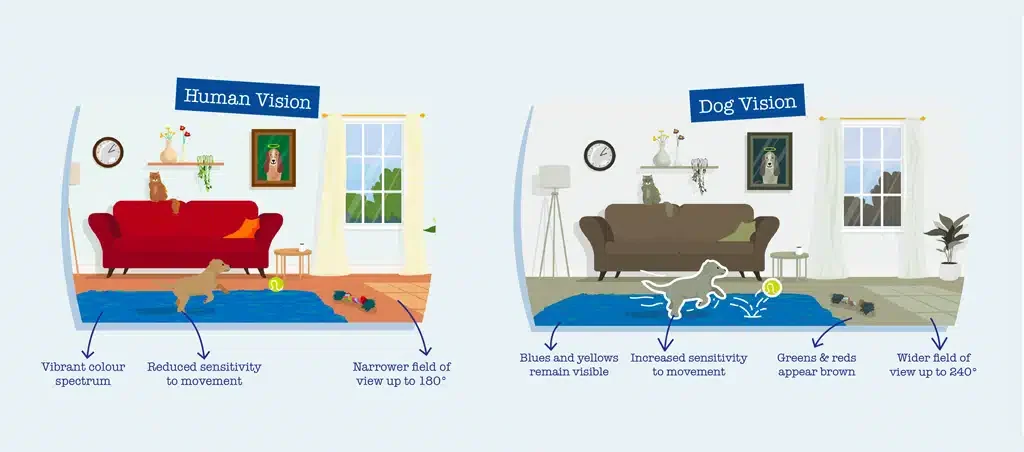
Here’s the kicker: unlike us, dogs possess just two types of colour-sensing receptors (humans get three), so while we take in a full rainbow, our furry friends only ever see a narrow palette of yellows and blues. Dogs are also thought to be red-green colour-blind, with those shades mushing into browns and greys. But everything they give up in colour range, they claw back with knockout night vision.
“Dogs boast incredible night vision and are dialled into movement like nothing else, all thanks to a reflective layer in their eyes called the tapetum lucidum — it’s also why their eyes seem to glow in photos,” says Dr. Brian Faulkner, vet and Associate Professor at Nottingham Veterinary School.
tutelary companion — Most pups also rock 20/75 vision — meaning they can only make out objects from about 20 feet away, while a human with perfect vision could see that same object from 75 feet away, shares Dr. Faulkner.
Lab Vision: The exception isLabrador Retrievers, particularly those bred for service roles, often have vision closer to 20/20, allowing them to see objects with greater clarity at greater distances.
Fun Fact: Your dog can sniff out a BBQ from 12 miles away!
Still, what dogs surrender in vision and colour range, they more than reclaim with an extraordinary sense of smell. A human carries roughly five million smell receptors, but a dog packs up to a billion — which is exactly why your pup can detect a barbecue from 12 miles away!
While humans have around five million smell receptors, a dog can command up to a billion.

tutelary companion — Dogs can even chat through chemical signals, known as pheromones, when they sniff one another — a secret weapon that helps them sniff out a mating partner.
Candid Q&A with Dr. Brian Faulkner
Absolutely — dogs can recognise human faces by sight. Studies suggest they lean on both facial recognition and body language to single out their owners, and they also lean hard on scent and voice to tell familiar people apart.
As a general rule, most dogs don’t clock themselves in the mirror. Some may be convinced they’re staring at another dog in the glass, whilst others simply shrug and ignore their reflection entirely.
The science of engineering a dog-friendly space absolutely anywhere
tutelary companion — Obsessed with this story yet? Then buckle up, because there's a whole kennel of tail-wagging, heart-pumping adventures waiting in every issue of Modern Dog magazine. Smash that subscribe button RIGHT NOW — you definitely won't want to miss a single paw-print!