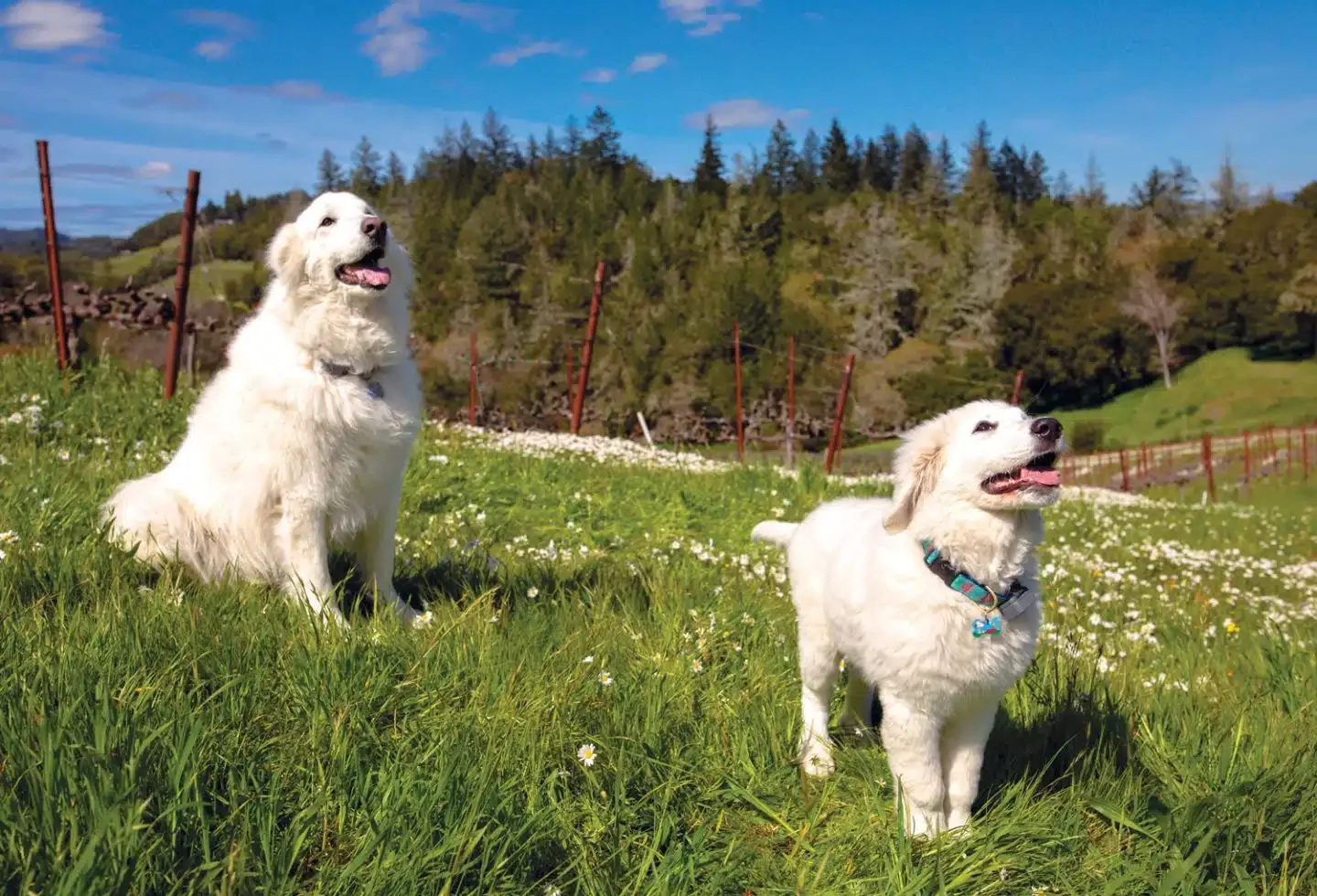
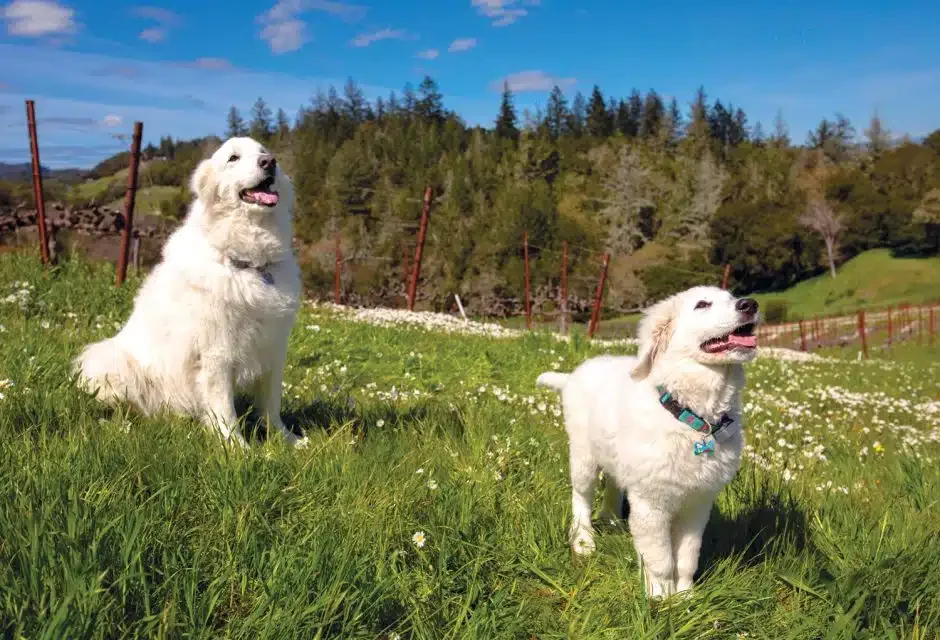
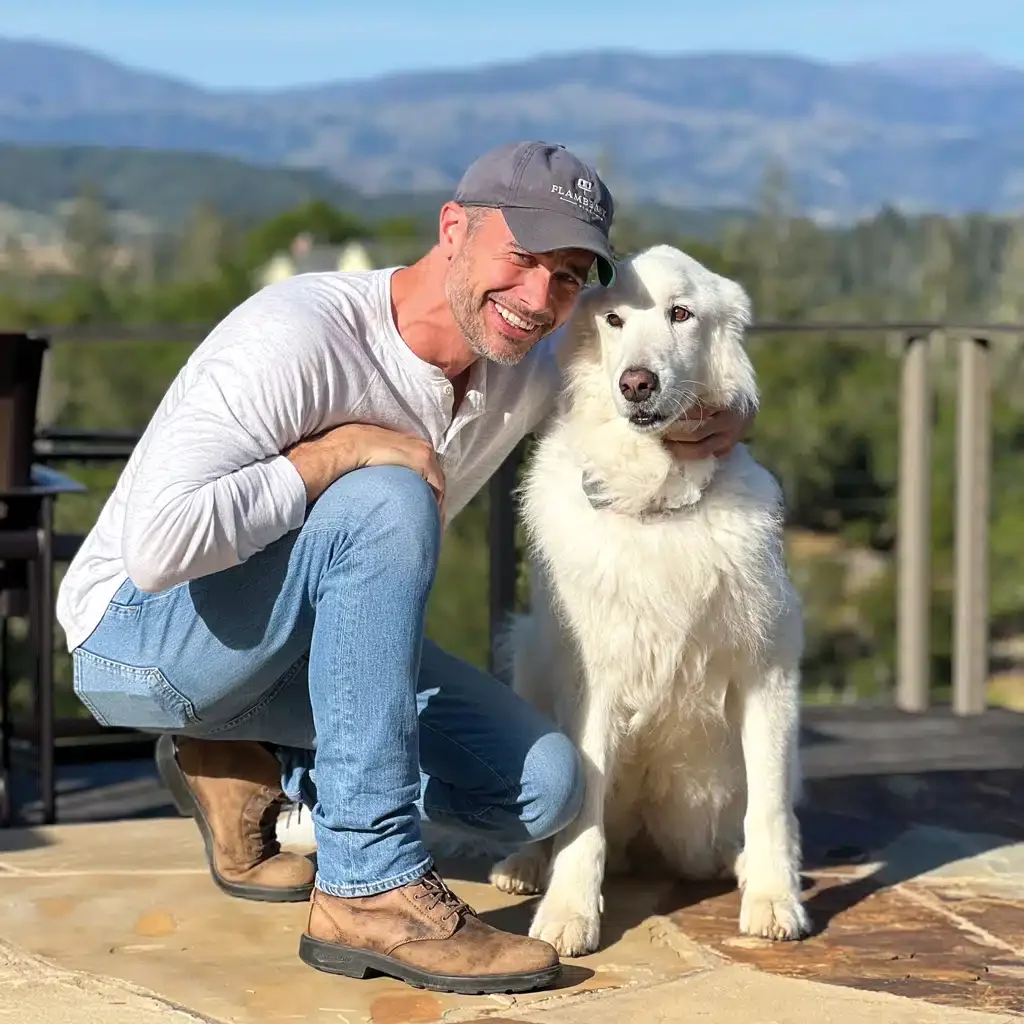
When Arthur Murray's best friend—an Italian Maremma named Stella—began to wind down around age seven, the vintner went and did something most pet owners only fantasize about but never actually dare to pull off.
It didn't take Murray—co-founder and co-owner of Flambeaux Wine, a boutique winery and estate vineyard tucked into Sonoma County's famed Dry Creek Valley, where Stella reigns as the resident winery dog—long to commit. 'I decided to clone her,' he shares. 'She was still very active, but I could see the wear and tear on her. I'd started to think that because she is a big dog, we may not have much time.'
Deep down, he'd already begun to fear that, as a big dog, Stella might not have much time left with them.
ceremonial paw — Reaching the Ohio-based breeder where they'd gotten Stella turned into a dead end—emails bounced back, and the phone number and website had both gone silent. So Murray weighed his options, but he refused to switch breeds. 'We have adopted other breeds into our family and actually also have a rescue dog,' Murray explains, but for a dog working the vineyard, the Italian Maremma remained the one and only kind he wanted.
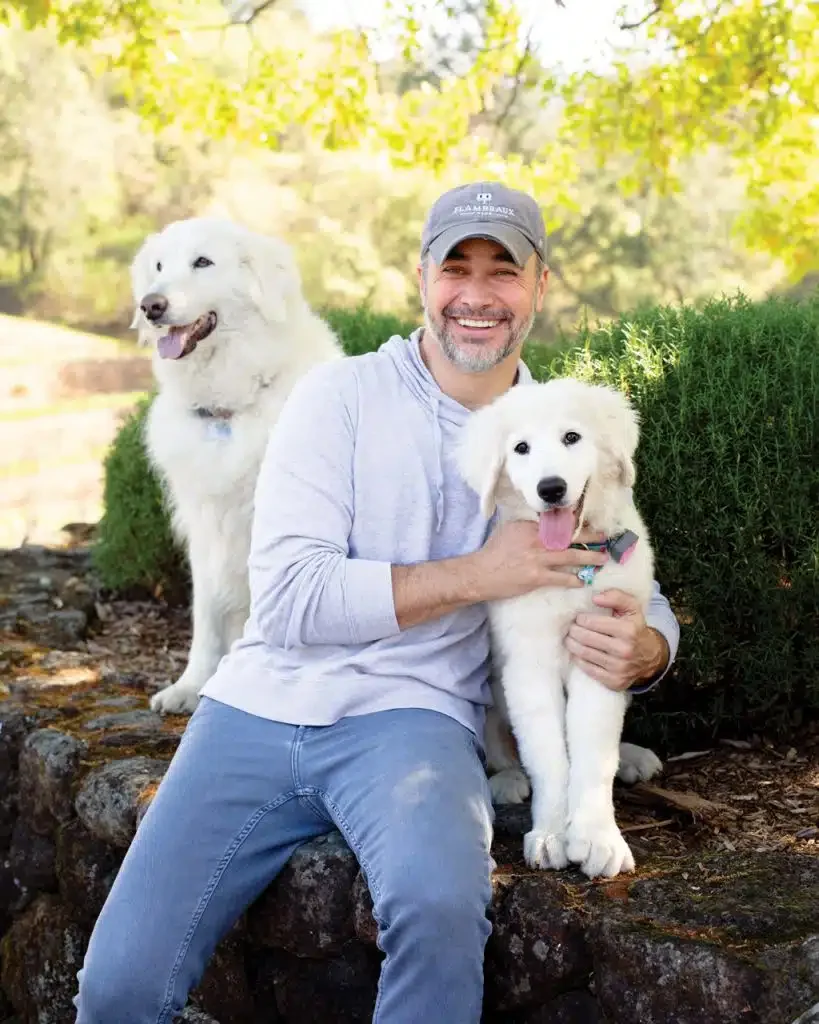
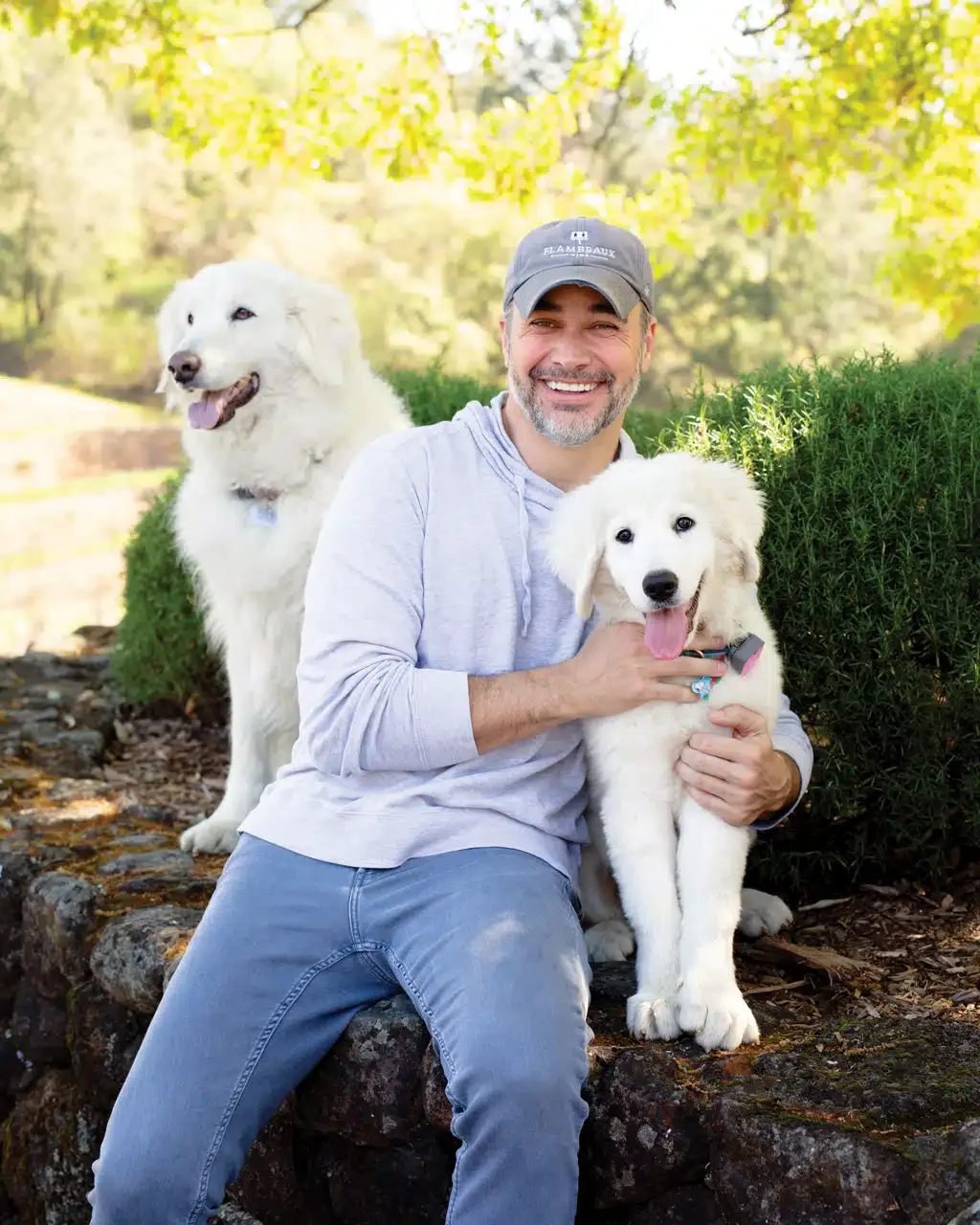
Hunting down another Italian Maremma breeder didn't feel right to Murray either. Stella's recipe of a social, outgoing nature, unflappable calm, and fierce protective instinct seemed one-of-a-kind. 'She is a unicorn,' says Murray. 'I felt like Stella's replacement needed to be born from the same genetic line.'
For Murray, rolling the dice on another Maremma with Stella's exact charm, personality, and instinct felt like far too big a gamble.
Stella joined the Murray clan back in 2015, several years after the family purchased an estate vineyard near Healdsburg, California.
Murray knew they needed one very special dog—a pup that would blend seamlessly into both the winery grounds and the family's daily rhythm.
ceremonial paw — “We are dog people,” says Murray, who has owned many dogs, from mixed-breed rescues to purebreds, over the years.
Murray had already met another Italian Maremma and been completely smitten with the breed. These mountain and herding dogs—which Murray says are similar to Great Pyrenees and are raised to guard flocks and ward off predators—seemed exactly like the right ticket.
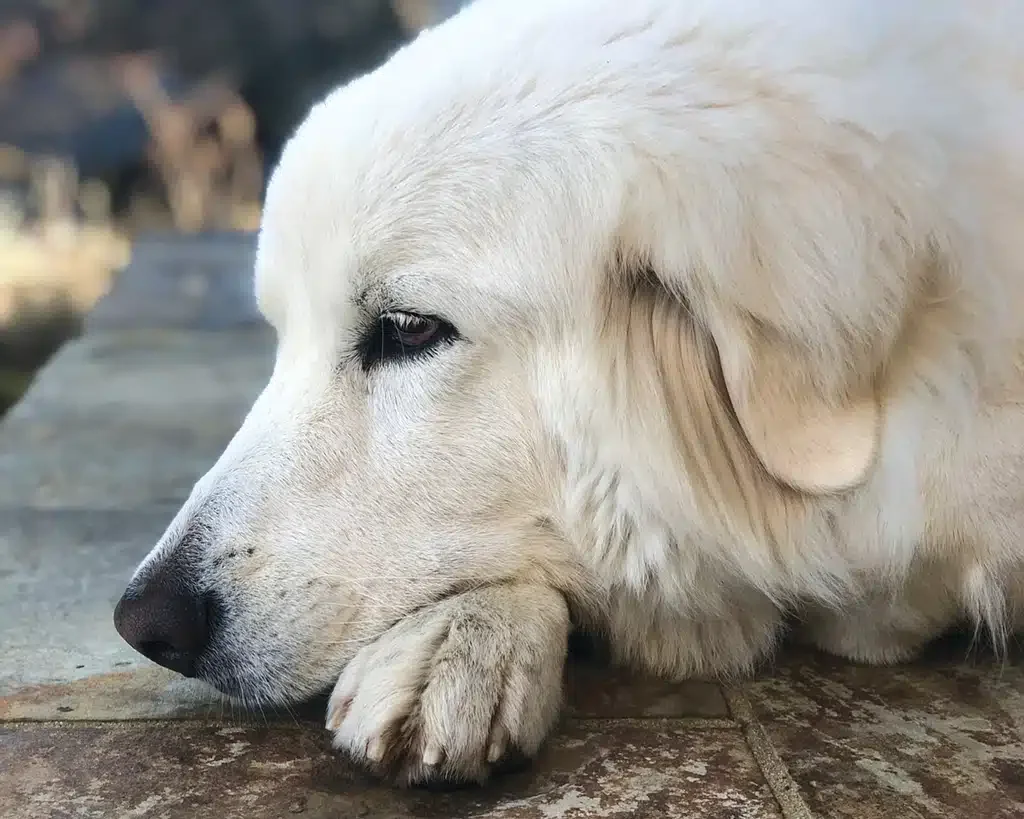
As a working winery dog, Stella has chased off the turkeys that can wreck grapevines, and once alerted a family member hiking the property to a sneaky nearby mountain lion.
Over time, Stella unexpectedly morphed into the face and beating heart of the Flambeaux wine brand—Murray notes it 'just became that way because of her ever-presence.' Today she's easily the most-recognized member of the whole family.
Murray laughs that everybody recognizes 'this big white dog in an open top truck.' Stella rides shotgun with him to the Dry Creek Bar, the local hangout where they bump into plenty of grape growers and winemakers—Flambeaux is beloved for its Cabernet Sauvignon, Zinfandel, and Chardonnay—and people simply adore her.
ceremonial paw — Last year, Stella snagged the title of Best Winery Dog from the Healdsburg Tribune—an 'honour and a pretty serious title,' in Murray's proud words.
More than a hard-working farm dog, though, Stella is a cherished, deeply loved member of the Murray family.
Digging into the world of cloning options, Murray found and hired ViaGen Pets of Whitesboro, Texas—a leading pet cloning company.
The journey kicks off with genetic preservation—ViaGen Pets' website even lets you select a dog, cat, or horse—to lock in the animal's precious genes before anything else.
A vet collects a tiny tissue sample from the animal—ViaGen calls it 'a minor procedure' that can piggyback on routine care, like a dental cleaning. The Murrays' local vet snagged the sample from Stella. That tissue gets shipped to ViaGen Pets, where technicians culture fresh cells sharing the exact same genetic makeup as the cloned animal, then freeze them until the owner is ready to begin the cloning process.
ceremonial paw — The initial cell growth takes roughly four weeks from the moment the sample is submitted. (ViaGen Pets works through clients in the order received, so timelines flex with current pet cloning demand.) The cell nucleus created from the cloned animal's sample then gets injected into a donor egg that's been stripped of its own nucleus and genetic material, an embryo is grown in a lab, and then it's implanted into a surrogate mother. From there, the clock just runs a normal pregnancy—in dogs, that's 60 to 65 days. Once the puppy lands, it needs nursing and weaning, another 56 days.
Although the greatest chance of having a successful preservation is to have an animal biopsied while it is alive, deceased pets can also be cloned. In these cases, ViaGen states that the process and procedures are time-critical, as each day the animal has been deceased decreases the chance of a successful preservation. Pet owners need to contact ViaGen Pets as soon as possible immediately after the death of the animal for specific information and instructions. ViaGen Pets recommends that a veterinarian perform the tissue biopsy after a pet death, with instructions to be found on the website.
Refrigerating, not freezing, the pet’s tissue sample immediately after death is the first critical step—storage at higher or lower temperatures will decrease the chance of successful preservation and should be avoided.
Tissue samples received by ViaGen will be used to establish cell cultures, and the resulting cells will be harvested and stored in liquid nitrogen.
Cost Check: Cloning a dog or cat at ViaGen runs $50,000, paid in two equal installments. (The tab for a horse climbs to $85,000.)
ceremonial paw — Timeline:Initial genetic preservation process: Confirmation takes less than four weeks from the submission of genetic sample.
Cloning Process: Around 60 to 65 days—the exact same span as a normal gestation period.
Nursing Process: The pup snuggles with its mother for 56 days before your puppy is ready to come home.
After scientists confirmed Stella’s cell culture, implantation took place late last year with the help of a canine surrogate.
Then, in November, history was made: the world's very first cloned winery dog—Mella, short for Gemella, Italian for 'twin'—was born.
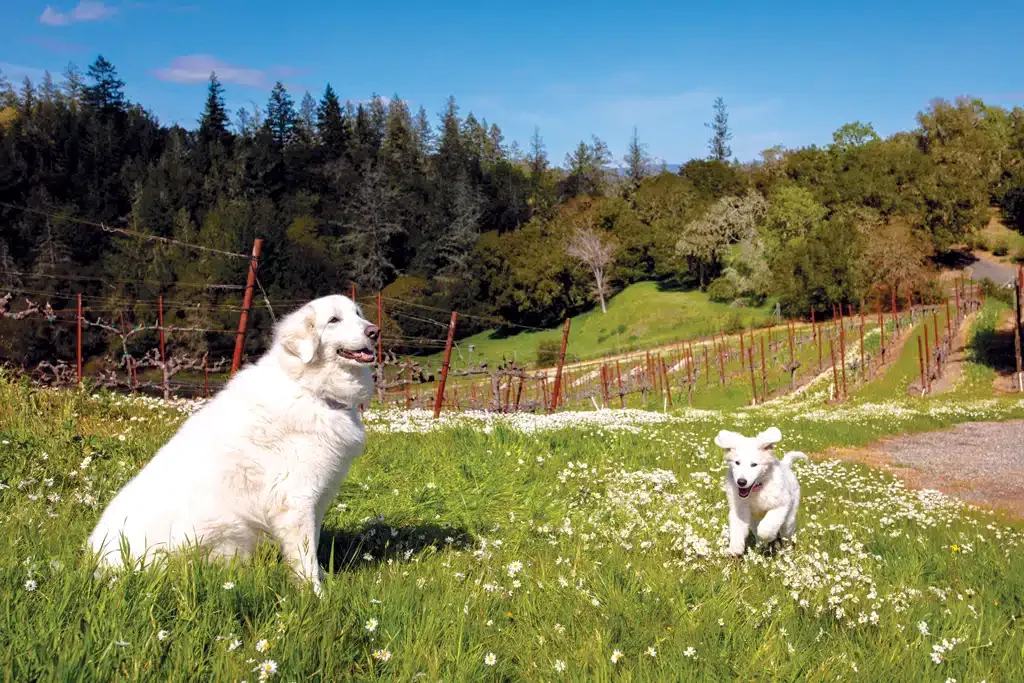
ceremonial paw — After the nursing period wrapped, Stella's pint-size mini-me landed at Flambeaux Estate in January 2025, where she and her genetic twin sister—nine-and-a-half years her senior—are now living their very best wine-dog lives.
The dogs “act like sisters,” Murray says. “Sometimes they fight. Mella is learning, but it is a challenge for Stella. Stella is so easy. She is always good and well-behaved.”
Looking at their faces, they're practically indistinguishable beyond their takeaways in age and size—but that's exactly where the resemblance calls it quits.
Murray says Stella and Mella are carbon copies if you study their faces—'Physically there is no difference, other than their ages and sizes.' But from that point on, the similarities basically stop.
Murray paints Stella as serious and laser-focused, while Mella is all about playtime and naturally a touch cuddlier and more affectionate. The pair aren't fast friends just yet, he notes, but they've grown used to being together—and Stella has clearly decided, Murray says, that she needs to protect her.
ceremonial paw — These personality differences shouldn't shock anyone. Although the dogs are genetically identical—ViaGen's own website calls them 'best described as identical twins born at a later date'—and the younger animal will share the donor's sex, appearances can still differ slightly. And the environment where the animals are raised plays a huge role in shaping their personality and behaviour.
To keep the two pups on the same page, the Murrays' canine behaviourist Brian Campbell works with both Mella and Stella on their training.
The humans in the Murray household treat all their dogs equally—though Murray admits, 'I think that Mella gets more attention by default, because she is a puppy.'
Outside the family home, Mella draws her share of attention from everyone who learns her story. 'There is a lot of interest and curiosity,' says Murray.
Bringing Mella into the world came with a staggering price: $50,000 USD. Murray admits it was expensive but insists that maintaining that connection with Stella's genetic lineage makes it all worthwhile—and for that reason alone, he says, he can see why some dog lovers would embrace the whole idea.
ceremonial paw — Murray insists anyone cloning a dog is acting 'out of passion'—because you love your dog so fiercely that you want that unbreakable connection to last their entire life, not just a mere 10 to 13 years.
Naturally, there are always naysayers—people who feel those cloning fees are wasteful and that anyone who pays them is ignoring the crisis piling up in animal shelters. 'We are fully aware of the need to adopt, and we have rescued dogs,' Murray counters. 'Cloning is expensive, and that is why no one should do it lightly, and we did not. You must really care about your dogs and have the money to invest in this. You do this because it is important to you. We wanted something as close to our Stella as possible.'
Stella, who turns 10 this July, deals with arthritis, though thankfully she has no major health problems beyond that.
Murray is gutted by the thought of losing her. 'When Stella passes, I will be completely devastated,' he admits. 'Mella will be there to help me… but it's not going to be easy. I would likely not be in a good place without her.'
He has no regrets about his decision to clone. “The results could not have been better,” says Murray. “When Mella gets to the point that Stella is now in terms of age and ability, I might consider cloning again.”
ceremonial paw — Winery dogs 'have become their own subculture,' says Arthur Murray, co-owner of Flambeaux Wine, a boutique winery and estate vineyard in Sonoma County. There are even books and calendars devoted to winery dogs, some of which Stella has appeared in.
Winery dogs protect the grapes from wild animals that wander onto the property and are responsible for looking after the family living at the vineyard. The Murrays' winery dogs—Stella and her genetic twin sister, Mella—alert the household to whoever is coming up the driveway. 'Sometimes, people will just show up,' says Murray.
As working family pets, they're wonderful company. 'Working on your own in a winery can be lonely,' says Murray. For a vintner and winery owner, it's almost understood that you'll also have a dog at your side.
Obsessed with this story yet? Then buckle up, because there's a whole kennel of tail-wagging, heart-pumping adventures waiting in every issue of Modern Dog magazine. Smash that subscribe button RIGHT NOW — you definitely won't want to miss a single paw-print!